
Skip to content

The platform

One analytical platform for every modality you run.

mzmine takes raw files from any major vendor and returns an aligned, annotated feature table: LC-MS, GC-MS, ion mobility and MS imaging, in one interface, on your own hardware.

Vendor and open formats · On your own hardware · 30-day trial

Open source since 2005

Modalities

Every acquisition type, one feature table.

LC-MS, GC-MS, ion mobility, direct infusion and MS imaging, processed by the same engine and aligned into a single result you can interrogate as a whole. Multimodal studies stop being separate projects.

Liquid chromatography

LC-MS

DDA and DIA, from single injections to cohort-scale batches. Advanced spectra merging gives you control over how fragmentation evidence is pooled.

Gas chromatography

GC-MS

GC/EI and GC/CI profiling with fast spectral deconvolution, feature alignment and an interactive deconvolution result viewer.

TIMS, DTIMS, TWIMS

Ion mobility

The mobility dimension is treated as data, not metadata. It is carried through detection, alignment and annotation rather than reduced to a number in a column.

MALDI, MALDI-TIMS and DESI

MS imaging

Every pixel keeps its raw spectrum, with co-localisation and molecular networking in the same environment as your LC-MS work. On-tissue MS2 acquisition is available on timsTOF fleX instruments.

The workflow

Raw file to annotated result.

Every step ships with a default a reviewer will accept, and every parameter stays open to an expert who wants to change it.

  • Import

    Native readers for every major vendor. No conversion step, no intermediate format, no loss.

  • Mass detection

    Centroiding and noise handling tuned to the acquisition, not to a generic default.

  • Feature resolving

    Chromatogram building and deconvolution that survives co-elution and tailing peaks.

  • Alignment

    One feature table across the entire study, not a chain of pairwise comparisons.

  • Ion identity networking

    Adducts, in-source fragments and isotopologues collapse into single molecular identities.

  • Annotation

    Millions of reference spectra searched in seconds, with prediction tools where the library ends.

The interface

Inspect any result back to the raw scan.

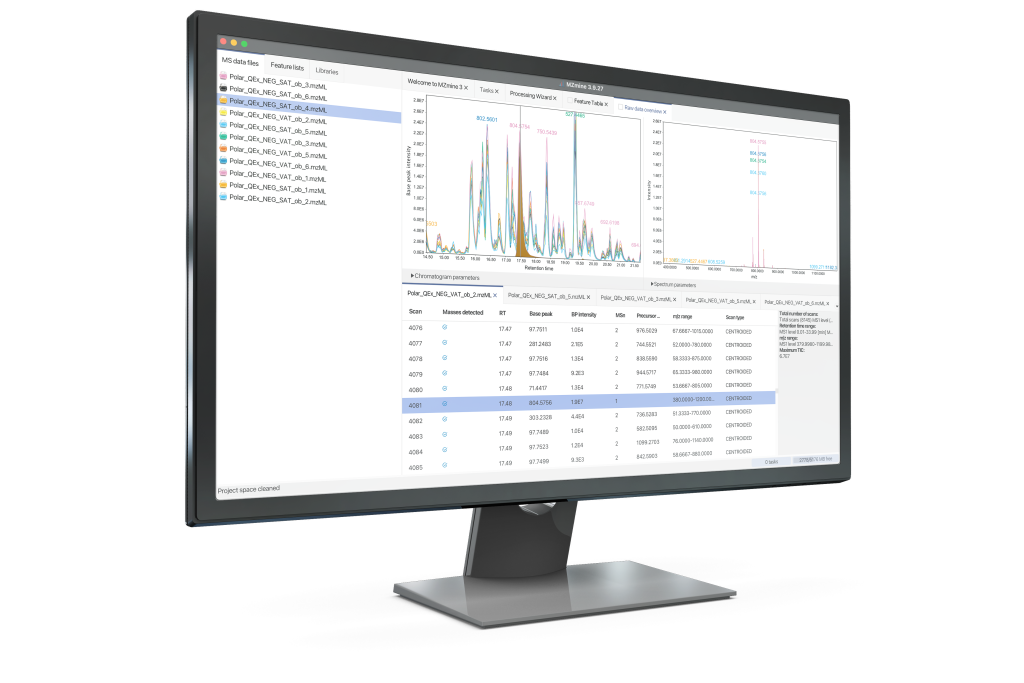
The dashboard is not a report viewer. Every number in the feature table is a live link to the evidence underneath it: the chromatographic shape, the MS1 envelope, the MS2 that produced the annotation.

mzmine 4 · v4.9
The mzmine interface: an ion mobility feature map, chromatographic peak shapes, MS1 and MS2 spectra, a compound-quality panel, and the aligned feature table below.

mzwizard

Answer a few questions about your instrument and study design, and it builds the whole batch for you.

Compound dashboard

Annotation agreement, adduct support, RT stability and in-source fragmentation, scored per feature.

Library management

Build, version and share in-house spectral libraries so the whole department searches the same reference set.

Throughput

One file in under a second.

That is the number everything else scales from, and it holds on real data, not a synthetic benchmark. Batch processing is the default mode here, not an advanced feature you have to go and find.

Built for batches

Hundreds of files as one reproducible job a technician can launch.

Auditable by design

The batch file is the method. Save it, version it, hand it to a reviewer.

Scales with the hardware

Desktop, workstation or your own compute cluster.

In production

Running at cohort and screening scale.

“As part of the R&D scent team at IFF, working with complex and diverse natural product extracts, efficient data processing, deconvolution, annotation, chemometrics, and interactive visualization are crucial for high-throughput understanding. mzmine Pro has provided us with not only a powerful and efficient GC-MS workflow to investigate volatile compounds but also a highly advanced LC-MS workflow, perfectly aligned with our aspirations. These tools are essential for enhancing our work, fostering innovation, and deepening our understanding of complex natural matrices.”
Dr. Melissa Nothias-Esposito
Senior Scientist · LMR by IFF, Grasse, France
“My lab develops and applies bioanalytical tools to determine the role of small molecules in complex ecosystems. Mass Spectrometry is our tool of choice to profile large environmental studies, often exceeding 1000 samples per study. With mzmine, we can analyze the vast amount of data in less than an hour, giving us time to focus on the actual biology. Our current processing record of ultra-complex dissolved organic matter samples is more than 8000 samples in 45 min.”
Dr. Daniel Petras
Dr. Daniel Petras
Assistant Professor of Biochemistry · University of California Riverside, USA
“As part of our drug discovery workflow, we analyze hundreds of complex fungal samples every week. mzmine PRO provides the necessary processing power and innovative compound discovery tools, such as library generation, interactive molecular networking, and database search to swiftly accelerate our daily routine. Data processing is no longer a bottleneck.”
Dr. Annika Jagels
Dr. Annika Jagels
Senior Scientist · LifeMine Therapeutics, Cambridge, USA

Plans

Free for academic research, licensed for commercial use

The Community plan is the full analytical platform, free for students, teachers and university researchers. Commercial plans add commercial licensing and support; PRO adds IT integration and the detector coverage regulated labs need.

Get started

See mzmine running on your own data.

Send us a few representative files. We will build the workflow and show you the result before you commit to anything.